What Are the Top 10 Types of Concrete Formwork?
Concrete formwork is the temporary mold and support system that gives fresh concrete its shape. It also holds wet concrete, workers, and equipment until the structure can support itself. A small gap at a panel joint can leave fins or leaks; weak bracing can cause costly delays. The details matter.
Mary Krumboltz Hurd, author of Formwork for Concrete, is a respected formwork specialist. The following line is an editorial summary of a practical principle, not a verbatim quotation: “Good formwork is temporary, but its decisions shape permanent concrete.” That distinction matters. Formwork choice depends on the pour, finish, site access, reuse plans, and loads—not simply the material price.
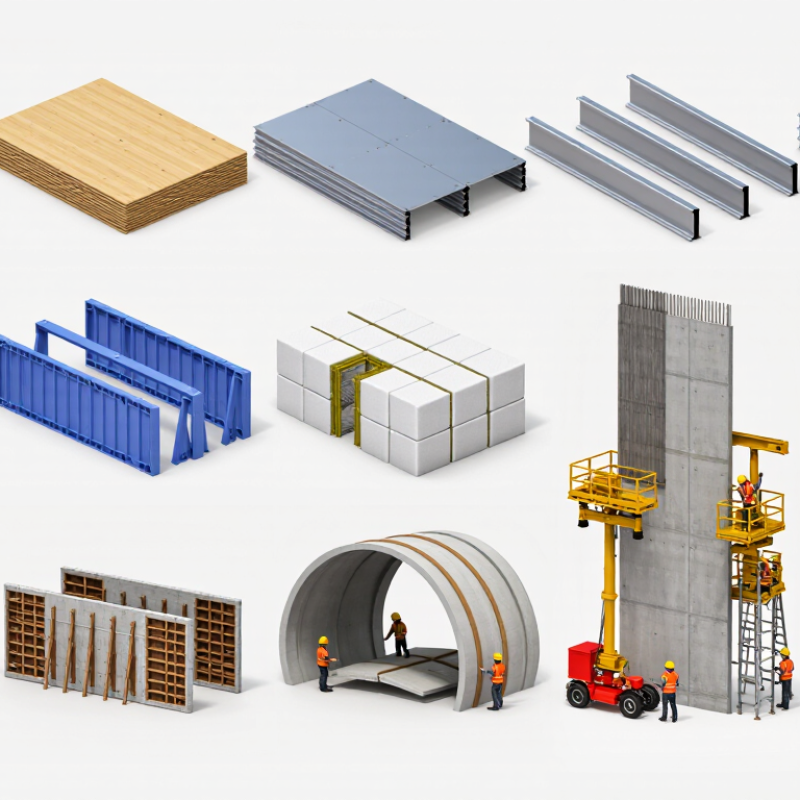
This guide introduces ten common types: timber, plywood, steel, aluminum, plastic, insulated, stay-in-place, tunnel, slipform, and climbing formwork. Each has trade-offs. Timber can be adapted on site, while steel panels offer durability and repeatable dimensions. Slipform systems suit continuous pours, but they demand careful coordination. The categories are not perfectly tidy; some describe materials, while others describe construction methods. That can be confusing.
Look closely at the edges. Compare setup time, joint quality, handling, and cleaning between pours. Consider how a system fits the crew and the actual project—not just a catalog photo. No single formwork type suits every job. This overview provides a starting point, not a substitute for project-specific design, manufacturer instructions, or qualified engineering review.
Concrete Formwork: Purpose, Components, and Core Principles
What Are the Top 10 Types of Concrete Formwork?
Concrete formwork gives fresh concrete its shape, alignment, and temporary support. Its core components include panels, walers, ties, braces, shores, release agents, and access platforms. Common systems include timber, plywood, steel, aluminum, plastic, insulated concrete forms, tunnel, climbing, slip, and stay-in-place formwork. Each option serves a different pressure, cycle-time, and finish requirement.
The American Concrete Institute’s ACI 347R guide stresses proper design for lateral pressure, construction loads, and deflection control. That guidance matters when concrete rises quickly inside tall wall forms. A small tie-spacing error can leave visible honeycombing or a dangerous bulge. On active sites, teams also check panel joints, brace angles, and base cleanliness before each pour. Simple checks prevent expensive repairs.
A 2024 report by Grand View Research estimated the global concrete formwork market at about USD 7 billion in 2023. It also identified modular and reusable systems as major growth areas. This reflects a practical concern: repeated use can reduce material waste and labor time. Still, “fast” does not always mean “better.” Aluminum may improve cycle speed, while timber can suit irregular geometry. My first layout would rarely be perfect without a trial assembly. Weather, concrete temperature, and crew experience can change the result. The overlooked detail is often the release-agent coverage.
| No. | Formwork Type | Typical Applications | Primary Components | Key Advantages | Main Limitations | Typical Reuse Potential |
|---|---|---|---|---|---|---|
| 1 | Timber Formwork | Small buildings, irregular shapes, alterations, and projects with limited repetition. | Sawn timber, plywood or boards, nails or screws, walers, braces, and ties. | Flexible, easy to cut on site, widely available, and suitable for complex geometries. | Labor-intensive; vulnerable to moisture, warping, damage, and dimensional variation. | Low |
| 2 | Plywood Formwork | Walls, slabs, beams, columns, and general reinforced-concrete construction. | Film-faced or structural plywood panels, timber or metal framing, ties, walers, and props. | Provides a relatively smooth finish, is lightweight, and can be adapted to many layouts. | Edges and faces can deteriorate if not sealed, cleaned, and stored correctly. | Medium |
| 3 | Steel Formwork | Repeated wall, column, beam, slab, foundation, and infrastructure work. | Steel panels, stiffeners, clamps, adjustable ties, walers, brackets, and supports. | High strength, accurate dimensions, durable surfaces, and strong resistance to deformation. | Heavy to handle, may require lifting equipment, and has a higher initial cost. | High |
| 4 | Aluminum Formwork | Repetitive residential and commercial projects with standardized room layouts. | Lightweight aluminum panels, pins, wedges, wall ties, props, and corner accessories. | Lightweight, fast to assemble, dimensionally stable, and suitable for repeated cycles. | Less economical for one-off or highly irregular structures; requires careful planning. | High |
| 5 | Plastic Formwork | Modular walls, columns, footings, landscaping elements, and smaller concrete works. | Reusable polymer panels, connecting clips or pins, corner pieces, braces, and supports. | Lightweight, easy to clean, resistant to corrosion, and suitable for manual handling. | Lower stiffness than steel; excessive heat, impact, or poor support can cause deformation. | High |
| 6 | Tunnel Formwork | Repetitive cellular buildings where walls and slabs are cast in large integrated sections. | Large reusable half-tunnel units, steel frames, leveling systems, lifting points, and release equipment. | Fast floor-cycle production, consistent geometry, and reduced formwork assembly between pours. | Best suited to repetitive layouts; transportation, lifting, and setup require careful coordination. | High |
| 7 | Slip Formwork | Tall silos, chimneys, cores, towers, and structures with continuous vertical geometry. | Continuous form panels, hydraulic jacks, yokes, working platforms, rods, and monitoring systems. | Enables continuous construction, reduces horizontal joints, and can achieve rapid vertical progress. | Requires continuous concrete supply, precise control, skilled supervision, and reliable equipment. | High |
| 8 | Climbing Formwork | High-rise cores, bridge piers, towers, retaining structures, and large vertical faces. | Form panels, climbing brackets, anchors, platforms, rails or guides, and lifting systems. | Allows the form to move upward in stages and reduces dependence on ground-based access. | Needs engineered anchorage, lifting procedures, wind assessment, and specialist supervision. | High |
| 9 | Stay-in-Place Formwork | Foundations, walls, bridge components, marine works, and areas with difficult stripping access. | Permanent panels or units made from concrete, fiber-reinforced material, metal, or polymer systems. | Eliminates stripping work, may provide protection or reinforcement support, and can speed construction. | The form remains part of the structure, so inspection, detailing, and compatibility must be verified. | Not Applicable |
| 10 | Insulating Concrete Formwork (ICF) | Energy-efficient residential, commercial, basement, and below-grade concrete walls. | Insulating foam blocks or panels, integral webs, alignment bracing, ties, and concrete infill. | Combines formwork and insulation, improves thermal continuity, and reduces stripping operations. | Requires accurate alignment, careful concrete placement, and coordination with finishes and services. | Not Applicable |
Related Posts
-
China Best Concrete Formwork Solutions for Global Buyers?
-
Why Choose Beam and Slab Formwork for Your Construction Projects?
-
2026 Best Types of Flexible Concrete Formwork?
-
How to Choose the Right Bracing Formwork for Your Construction Project
-
Ultimate Tips for Using Bulkhead Formwork Effectively?
-
Top 10 Bracing Formwork Solutions for Global Buyers?