Types of Scaffolding and Their Uses
There is ample evidence that people have been using staging, or as it is more commonly known, scaffolding, in one form or another since prehistoric times. More recently, the ancient Egyptians, Greeks, and Romans, who were all renowned for their prolific construction work and architectural prowess, also made extensive use of staging.
While the use of these structures is even more widespread today, there have been some marked changes to its design, and it is no longer an exclusive tool of the builder.
Most of that in use today is made from steel, and the main components of modern scaffolding consist of hollow tubing similar to water pipes. However, bamboo poles lashed together by ropes offer builders a more affordable option. Consequently, this age-old type of staging is still in use, particularly in the less affluent countries. However, when binding the poles together with ropes, there is a tendency for the joints to slip. Not only is metal tubing more durable, but the modern universal couplers ensure rigid, immovable joints that are more versatile and facilitate the assembly and dismantling processes.
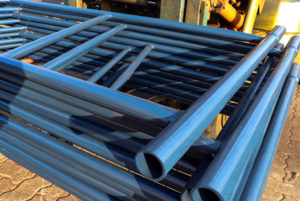
Whether indoors or outdoors, scaffolding provides a stable platform to support materials and workers when performing tasks at height and several types are available, depending upon the intended use. For indoor use, a simple form of staging, consisting of wooden boards supported on trestles, offers a means for painters and decorators to access an entire wall without constantly repositioning and climbing a ladder. However, this arrangement is too unstable for use at heights greater than about five metres, so it is of limited value when performing outdoor work.
Single or double scaffolding are the main options for outdoor use. The former is frequently used for brick constructions and relies partly on horizontal poles inserted into holes in the wall for its support. A single row of vertical poles or standards provides the balance of support necessary to create a stable platform. When working on stone walls, the double variety is the option of choice. In this case, two rows of vertical poles provide all the necessary support. Because there is no physical attachment to the wall, this type is also described as independent staging.
A third type, known as cantilever scaffolding, is sometimes necessary to work in locations where support from the ground is unavailable or impractical. In such cases, an extension to a conventional scaffold could provide access to the awkward area, or the structure might derive all its support from the building. In the latter case, workers may need to gain access to the cantilever structure via an adjacent balcony.
Disc-O-Scaff specialises in innovative and safe solutions for working at height.