The increased demand for additional building infrastructure has enabled the construction industry to grow in leaps and bounds through the various uses of formwork. Where once it took years to complete commercial builds, it is now done in mere months, affording architects and construction companies alike the ability to create the monolithic structures that adorn our urban landscape. Achieving the desired shape for any build can be done on-site with prefabricated quality formwork moulds from Disc-O-Scaff. In an ever-changing world, it is comforting to know that the basics of formwork have remained the same for thousands of years.
What Are the Advantages of Formwork?
The biggest challenge for any construction is sticking within the required time frames and budgets. As formwork requires minimal set-up and negates the need for cumbersome pre-made blocks of concrete to be transported to the site, it is a cheaper and faster way to complete a project. Having the advantage of being able to cast wet concrete into a desired mould on-site and wait for it to cure lowers the construction cycle time.
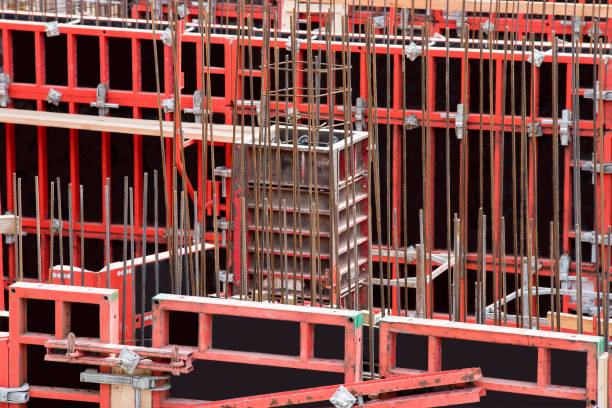
The Best Type of Formwork
Playing a vital role in construction is formwork. There are many different types of formwork available. However, steel seems to be the material of choice as it can be used multiple times, is cost-effective, and it is extremely durable. Steel moulds can be assembled quickly, requiring only minimal components to connect the panels and hold them in place.
The Prevention of Formwork Failures in Construction
As important as formwork is to a build, so is preventing formwork failures that could end up compromising structural integrity. Here are some common formwork errors that can be prevented:
- Not taking into account the load-bearing capacity against the temporary structure’s stability.
- Using components that are defective or have not been properly maintained.
- Removing the formwork before the concrete has had time to cure properly.
- Pouring the formwork onto a foundation that is not stable. It impacts the carrying capacity of the formwork.
To prevent any formwork mishaps, one should:
- Follow the assembly instructions set out by the manufacturer to the letter and inspect all the formwork components before using them.
- Make sure that the formwork is structurally sound and has been assembled correctly before pouring the concrete.
- Do not overload the mould when pouring the concrete.
- The minimum curing time must be reached before removing the formwork.
To prevent any formwork mishaps, one should:
- Follow the assembly instructions set out by the manufacturer to the letter and inspect all the formwork components before using them.
- Make sure that the formwork is structurally sound and has been assembled correctly before pouring the concrete.
- Do not overload the mould when pouring the concrete.
- The minimum curing time must be reached before removing the formwork.
The film and television industry uses scaffolding as part of their rigging. Lighting, sound, and camera equipment may need to be positioned at a higher angle to get the desired effect. For outdoor stage events, scaffolding is used to gain access to stage lighting and is sometimes used to strategically place speakers at a given height.

Durable Formwork Solutions
At Disc-O-Scaff, we pride ourselves on the fact that our formwork solutions are engineered in-house and manufactured using only quality SABS-approved materials. We have been supplying our steel prefabricated formwork and scaffolding to construction industries in South Africa for over 10 years. Contact us to find out how our solutions can work for you.