China Top 10 Round Column Formwork Manufacturers
China’s round column formwork industry serves projects ranging from bridges and industrial plants to commercial towers. This guide examines the China Top 10 Round Column Formwork Manufacturers through practical purchasing criteria. It focuses on engineering capability, product consistency, project experience, and after-sales support.
Round column formwork must create clean, accurate circular surfaces under real construction pressure. A reliable supplier should explain panel materials, adjustable diameters, connection systems, concrete pressure limits, and reuse cycles. Site teams also need clear drawings, installation guidance, and responsive technical communication. Small details matter. A poorly aligned joint can leave visible marks after stripping. Weak locking hardware may create delays during a concrete pour.
The companies discussed here should be evaluated through verifiable evidence, not attractive claims alone. Buyers can review factory capacity, quality-control procedures, testing records, export experience, and completed project references. Product samples can reveal surface finish and machining accuracy. Conversations with engineers may reveal more than a brochure.
No ranking is perfect. Manufacturer strengths can change with project scale, location, customization, and delivery conditions. Some suppliers may excel in steel systems, while others offer flexible plywood solutions. Certification alone does not guarantee field performance. It must support reliable production and safe application.
This overview aims to help contractors, distributors, and project owners compare suppliers with greater confidence. It also encourages careful checking before purchase. The best choice is rarely the cheapest quotation. It is the system that fits the structure, schedule, workforce, and long-term construction demands.
Definition and Role of Round Column Formwork in Construction
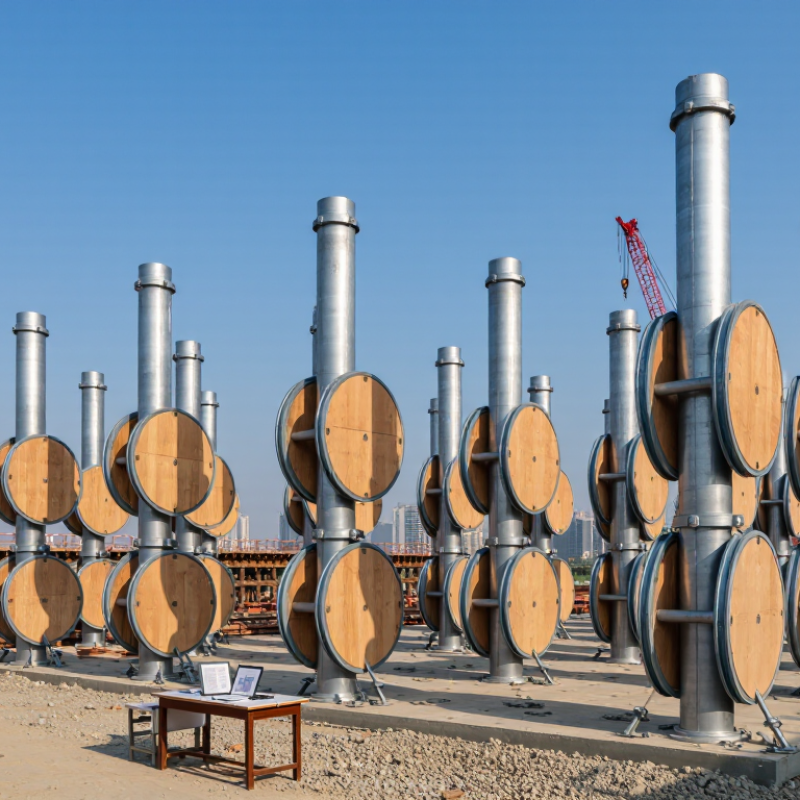
Round column formwork is a temporary mold used to shape fresh concrete into a circular structural column. It usually consists of curved panels, connecting clamps, ties, and adjustable supports. The form holds wet concrete until it gains enough strength to stand independently. Some systems are reused across multiple pours. Others are designed for limited applications.
Its role extends beyond creating a smooth surface. Accurate formwork controls column diameter, vertical alignment, and concrete cover around reinforcement. These details affect load transfer and long-term durability. On a working site, crews must check the base level before assembly. They also inspect joints for gaps, because leaking cement paste can create honeycombing. Proper bracing prevents movement during placement and vibration. Small shifts can become visible alignment defects.
Practical experience shows that round forms are not always simple to handle. Uneven ground, temperature changes, and rushed tightening can reduce accuracy. Release agents may also be applied unevenly. This can stain the surface or complicate stripping. Careful measurement remains necessary, even with precision-made panels. A reliable process includes checking the diameter, plumbness, connection strength, and concrete condition before each pour. Some mistakes are discovered only after removal. That is why site records and honest inspection matter. Formwork supports the column, but it cannot correct poor reinforcement placement or weak concrete practices.
China Top 10 Round Column Formwork Manufacturers - Definition and Role of Round Column Formwork in Construction
Technical comparison of common round column formwork systems and their construction applications
| No. | Formwork System | Typical Column Diameter | Primary Material | Typical Panel Height | Typical Reuse Potential | Main Construction Role | Key Technical Consideration |
|---|---|---|---|---|---|---|---|
| 1 | Fixed Steel Circular Formwork | 300–1,500 mm | Welded carbon steel | 1,000–3,000 mm | Approximately 100–300 pours with proper maintenance | High-strength columns, piers, and bridge supports | Panel alignment, lifting points, and concrete pressure control |
| 2 | Adjustable Steel Circular Formwork | 400–1,200 mm | Bolted or hinged steel panels | 1,000–3,000 mm | Approximately 80–250 pours | Projects with several column diameters | Adjustment accuracy and tightening torque at panel joints |
| 3 | Aluminum Circular Formwork | 300–1,000 mm | Extruded aluminum alloy | 600–3,000 mm | Approximately 100–300 pours | Fast-cycle residential and commercial construction | Lightweight handling and protection against panel deformation |
| 4 | Plastic Modular Formwork | 200–800 mm | High-impact polypropylene or composite plastic | 500–1,500 mm | Approximately 50–100 pours | Small- and medium-sized repetitive columns | Temperature sensitivity, joint tightness, and dimensional stability |
| 5 | FRP Circular Formwork | 300–1,500 mm | Glass-fiber-reinforced polymer | 1,000–3,000 mm | Approximately 50–150 pours | Architectural columns and projects requiring corrosion resistance | UV exposure, impact resistance, and release-agent compatibility |
| 6 | Paper-Tube Column Formwork | 150–1,200 mm | Spiral-wound paper with waterproof coating | 2,000–12,000 mm | Normally single-use | Fast construction of exposed architectural columns | Moisture protection, vertical support, and controlled stripping time |
| 7 | Steel Column Formwork with Climbing Brackets | 600–2,500 mm | Heavy-duty steel | 2,000–4,500 mm | Approximately 100–300 pours | High-rise cores, shafts, and tall piers | Anchorage, climbing sequence, wind protection, and working platforms |
| 8 | Insulated Concrete Form Column System | 200–600 mm | Expanded polystyrene with concrete core reinforcement | 600–1,200 mm | Permanent formwork | Energy-efficient walls and integrated structural columns | Fire performance, reinforcement placement, and concrete consolidation |
| 9 | Steel-Plate Pier Formwork | 1,000–4,000 mm | Reinforced steel plate with external stiffeners | 1,500–4,000 mm | Approximately 100–250 pours | Large bridge piers, marine structures, and industrial columns | Hydrostatic pressure, panel stiffness, and crane capacity |
| 10 | Hybrid Steel–Timber Circular Formwork | 300–1,500 mm | Steel frame with plywood or timber facing | 1,000–3,000 mm | Approximately 20–80 pours | Projects requiring flexible site fabrication and smooth finishes | Moisture protection, joint sealing, and facing replacement |
Note: Dimensions, panel heights, and reuse figures are typical industry ranges rather than guaranteed product specifications. Final selection should be verified against the structural design, concrete mix, pour rate, temperature, wind conditions, applicable Chinese standards, and the supplier’s engineering calculations.
Related Posts
-
Top Circular Column Formwork Manufacturers Worldwide
-
Top Circular Column Formwork Suppliers Worldwide?
-
Top Types of Concrete Column Formwork for Global Buyers
-

Top 10 Benefits of Circular Column Formwork in China Construction Industry?
-

Top Round Column Formwork Solutions for Global Buyers?
-
Top Advantages of Using Round Column Formwork for Construction?